
basal-ganglia
A spiking model of the basal ganglia for action selection. Feed in a utility vector, read out a one-hot selection signal.
Description
This is the Stewart / Choo / Eliasmith (2010) basal ganglia: a biologically-grounded action-selection circuit implementing the direct and indirect pathways through striatum (StrD1, StrD2), subthalamic nucleus (STN), and globus pallidus (GPi/SNr, GPe).
The model takes a dimensions-length input vector — interpreted as the "utility" of each candidate action — and produces an output vector that is approximately zero for the selected (highest-utility) action and strongly negative for the others. Downstream networks (typically a thalamus + cortex) can use this to gate action execution.
It's the canonical action-selection primitive used throughout the Spaun line of models and most CNRG cognitive architectures.
Installation
We recommend a fresh virtual environment to avoid Nengo/NumPy version conflicts with your global Python install:
python -m venv .venv
source .venv/bin/activate          # Windows: .venv\Scripts\activate
pip install -r requirements.txt
Usage
import nengo
from basal_ganglia import BasalGanglia

with nengo.Network() as model:
    bg = BasalGanglia(dimensions=3, n_neurons_per_ensemble=100)

    utility = nengo.Node([0.7, 0.5, 0.3])     # action utilities
    nengo.Connection(utility, bg.input)

    output_probe = nengo.Probe(bg.output, synapse=0.01)

with nengo.Simulator(model) as sim:
    sim.run(0.5)
See examples/example_usage.py for a 3-action demo where utilities change over time and the BG cleanly switches its selection.
How it works
Per Stewart, Choo & Eliasmith (2010):
- StrD1 (direct pathway striatum) and StrD2 (indirect) each receive the utility input through a soft-threshold nonlinearity (the cortico-striatal projection).
- StrD1 → GPi is inhibitory: high-utility actions silence their corresponding GPi neuron.
- StrD2 → GPe → GPi is doubly inhibitory: the indirect pathway disinhibits competing actions.
- STN → GPi is excitatory (diffuse): provides background drive against which the direct-pathway inhibition is detected.
- GPi/SNr is the output: zero (or near-zero) firing for the selected action, strong negative output for the rest.
Constants and weights follow the values in Stewart 2010, Table 1.
This implementation wraps nengo.networks.BasalGanglia from core Nengo, which is the same model — the wrapper exists to provide curated metadata, a tested example, citation info, and a stable Zoo-level API.
Citation
@inproceedings{stewart2010basalganglia,
  author    = {Stewart, Terrence C. and Choo, Xuan and Eliasmith, Chris},
  title     = {Dynamic behaviour of a spiking model of action selection in the basal ganglia},
  booktitle = {Proceedings of the 10th International Conference on Cognitive Modeling},
  year      = {2010}
}
License
GPLv2 (see LICENSE). Matches Nengo's license.
Figures
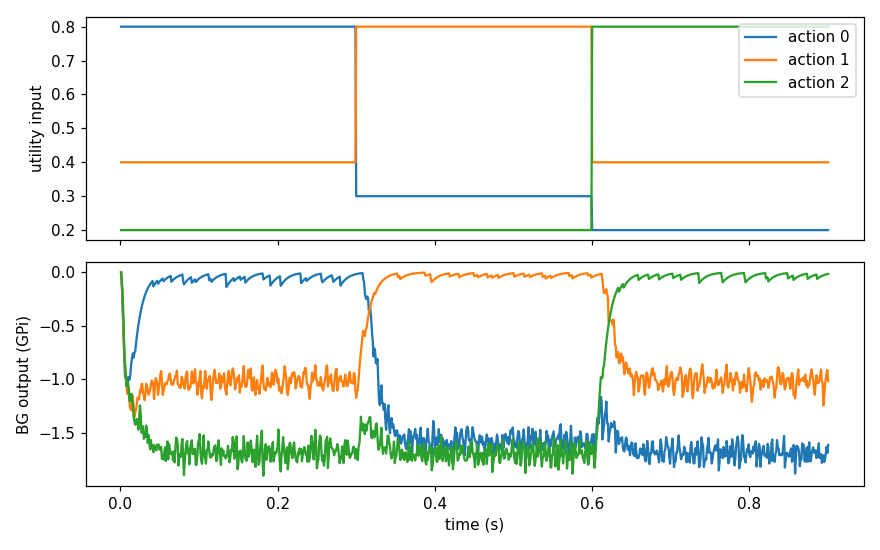
Three competing actions with utilities that swap every 0.3 seconds.
Top: the utility input for action 0 (blue), 1 (orange), and 2 (green).
Bottom: the basal-ganglia output (GPi) — near zero for the selected (highest-utility) action and strongly inhibited for the others. The network cleanly switches selection at each utility transition.
Generated by examples/example_usage.py.