
probability-encoding
A spiking-neural population that estimates a probability density from samples, using Spatial Semantic Pointers (SSPs) and a Function Inverse Estimator (FIE) normalization.
Description
Given samples drawn from a 1-D distribution, the encoder computes a Spatial Semantic Pointer representation mu of the empirical distribution and a normalization constant xi. It then builds a spiking neural ensemble whose firing rate at the SSP-encoded query point x approximates the probability density p(x):
rate(x) ≈ max_rate · max(0, mu · phi(x) − xi)
where phi(.) is the SSP encoding function from ssp_space and max_rate is the per-neuron gain.
The class exposes two construction modes via the encoders argument:
- Single-neuron (
encoders=None, default): one neuron withencoder = mu. Drive the network with a swept query SSP and the neuron's spike train traces the density over the sweep. - Population (
encoders = ssp_space.encode(query_points)): one neuron per evaluation point. Drive withmuand the per-neuron firing rates across the population approximatep(query_point).
Both modes share the same underlying ensemble construction — the encoder matrix is the only knob that differs. See examples/example_usage.py for both demos and examples/probability_encoding.ipynb for Michael Furlong's original tutorial.
Installation
python -m venv .venv
source .venv/bin/activate          # Windows: .venv\Scripts\activate
pip install -r requirements.txt
The SSP encoder comes from ctn-waterloo/ssp-bayesopt (Michael Furlong's ssp-bayes-opt package; the SSP classes live under ssp_bayes_opt.sspspace). It is not on PyPI, hence the git+https://… install.
Usage
import nengo
import numpy as np
from scipy.stats import beta as beta_dist
from ssp_bayes_opt import sspspace
from probability_encoding import ProbabilityEncoder

# 1. Training samples drawn from some 1-D distribution.
samples = beta_dist.rvs(2, 5, size=500).reshape(-1, 1)

# 2. SSP space (lengthscale will be set automatically from the data).
ssp_space = sspspace.RandomSSPSpace(ssp_dim=128, domain_dim=1)

# 3. Population variant: one neuron per query point. Construct the
# encoder INSIDE the parent network so Nengo can see it at build time.
query_xs = np.linspace(0, 1, 50).reshape(-1, 1)
with nengo.Network() as net:
    pop = ProbabilityEncoder(
        ssp_space=ssp_space,
        training_samples=samples,
        domain_bounds=(0.0, 1.0),
        query_points=query_xs,
        max_rate=50.0,
    )

    # 4. Drive with mu; per-neuron firing rates ≈ p(query_xs).
    stim = nengo.Node(lambda t: pop.mu)
    nengo.Connection(stim, pop.input, synapse=None)
    probe = nengo.Probe(pop.ensemble.neurons)

with nengo.Simulator(net) as sim:
    sim.run(0.1)

estimated = sim.data[probe].mean(axis=0) / 50.0
How it works
Given n training samples {x_i}, the encoder constructs the empirical SSP mean
mu = (1 / n) · Σ phi(x_i) / ls
where ls is a data-driven bandwidth (default: Furlong's empirical-characteristic-function estimator, falling back to Silverman). The normalization xi is chosen so that the density estimate integrates to 1 on the domain — concretely, by minimizing (1 − ∫ max(0, mu·phi(x) − xi) dx)² over xi via L-BFGS-B.
A Nengo SpikingRectifiedLinear ensemble with gain = max_rate · 1 and bias = −xi · max_rate · 1 then implements the relation
rate(x) ≈ max_rate · max(0, mu · phi(x) − xi).
The choice of encoders decides which "x" you're querying:
- default (no query_points) → one neuron whose tuning curve, evaluated by driving the input with phi(x), traces p(x).
- query_points = X → one neuron per query point, whose tuning curve evaluated at the constant input mu gives p(query_point).
See Michael Furlong's tutorial notebook (examples/probability_encoding.ipynb) for the full derivation and a Gaussian-mixture example.
Citation
This submission curates the spiking-implementation tutorial from the 2025 Nengo Summer School:
Furlong, M. (2025). Probability Encodings — Spiking Implementation.
Nengo Summer School tutorial.
https://github.com/ctn-waterloo/summerschool2025/tree/main/tutorials/vsa_probability
The vendored fie_util.py and ssp_util.py are included from the same source with the author's permission.
License
GPLv2 for this submission (see LICENSE). The upstream summerschool2025 repository declares no license; Michael Furlong has granted permission to ship the vendored utility modules under GPLv2 here.
Figures
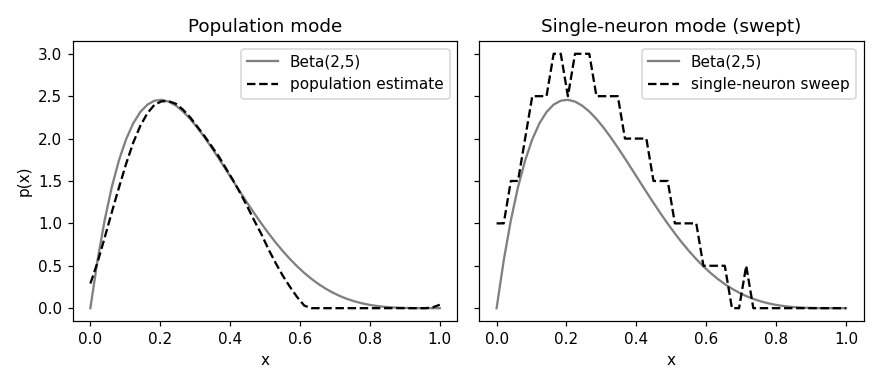
Demo: estimating a Beta(2, 5) probability density from 500 samples with a 128-dimensional random SSP encoder.
Left — population mode. 50 neurons, one per evaluation point on (0, 1), with encoders set to the SSPs of those points. The network is driven by the constant trained mean SSP mu; each neuron's mean spike rate over the 2-second run (normalized by max_rate=50) is plotted as the density estimate.
Right — single-neuron mode (swept). One neuron with encoder = mu. The input is a query SSP that sweeps linearly across (0, 1) over the same 2-second run; binning the spike train by the corresponding query value gives the noisier per-bin rate estimate shown. The single-neuron variant fundamentally has less averaging power per query point, hence the residual quantization.
Both modes share the same trained mu and FIE normalization xi — only the encoder matrix differs. Generated by examples/example_usage.py.