
ssp-path-integrator
A spiking neural path-integration network: given a continuous velocity signal, continuously updates a Spatial Semantic Pointer (SSP) estimate of position.
Description
This is a curated NengoZoo wrapper around the path-integration subnetwork from Dumont et al. (2023). It implements continuous path integration using velocity-controlled oscillators (VCOs) with attractor dynamics: each oscillator tracks one Fourier component of the SSP encoding of position, and the velocity input modulates the rotation rate of each component. The combined output is a continuously updated SSP that can be decoded back to (x, y) coordinates.
It's the localization half of the larger SSP-SLAM system in Dumont's Semantic-Spiking-Neural-SLAM-2023 repository — useful on its own as a biologically-grounded path integrator, or as a drop-in component for navigation / SLAM-style models that want SSP representations.
Installation
We recommend a fresh virtual environment to avoid Nengo/NumPy version conflicts:
python -m venv .venv
source .venv/bin/activate          # Windows: .venv\Scripts\activate
pip install -r requirements.txt
The sspslam package is pulled directly from Nicole Dumont's GitHub repository (it's not on PyPI yet).
Usage
import nengo
import numpy as np
import sspslam
from ssp_path_integrator import PathIntegrator

# 1. Build an SSP space.
ssp_space = sspslam.HexagonalSSPSpace(
    domain_dim=2, n_scales=2, n_rotates=3,
    domain_bounds=np.array([[-1, 1], [-1, 1]]),
    length_scale=0.2, seed=0,
)
d = ssp_space.ssp_dim

# 2. Wire it up.
with nengo.Network() as net:
    velocity = nengo.Node(lambda t: [0.5, 0.0])
    init_ssp = nengo.Node(
        lambda t: ssp_space.encode(np.array([[0.0, 0.0]])).flatten()
                  if t < 0.05 else np.zeros(d)
    )

    pi = PathIntegrator(ssp_space, n_neurons=500)
    nengo.Connection(velocity, pi.velocity_input, synapse=None)
    nengo.Connection(init_ssp, pi.input, synapse=None)

    out = nengo.Probe(pi.output, synapse=0.05)

with nengo.Simulator(net) as sim:
    sim.run(0.5)

# Decode the SSP back to (x, y):
xy = ssp_space.decode(sim.data[out], "from-set", "grid", 50)
See examples/example_usage.py for a complete demo with a circular trajectory and a path-comparison plot.
How it works
The SSP encoding maps a continuous position x ∈ R^N into a d-dimensional vector via the inverse FFT of complex exponentials whose phases are determined by a phase_matrix Φ ∈ R^(d × N). In the Fourier domain, the SSP factorizes into independent components, each of which behaves as a 2D oscillator whose angular frequency is proportional to Φ_k · v (the dot product of the velocity with the k-th phase vector).
PathIntegrator implements each such oscillator as a 3-dimensional Nengo ensemble: two dimensions for the real and imaginary parts of the Fourier component, one dimension that receives the velocity-projected frequency input. With stable=True, each oscillator additionally has attractor dynamics pulling the (real, imag) state onto the unit circle, which substantially improves accuracy over a plain harmonic oscillator. A final linear transform reads the SSP back out of the oscillator array.
See Dumont et al. (2023) for the math and the broader SLAM context.
Citation
@article{dumont2023exploiting,
  author  = {Dumont, P. Michaela Nicole and Furlong, P. Michael and Orchard, Jeff and Eliasmith, Chris},
  title   = {Exploiting semantic information in a spiking neural {SLAM} system},
  journal = {Frontiers in Neuroscience},
  volume  = {17},
  year    = {2023}
}
License
GPLv2 for this wrapper (see LICENSE). The underlying sspslam package is distributed by Nicole Dumont under its own license (Apache-2.0 per the upstream README).
Figures
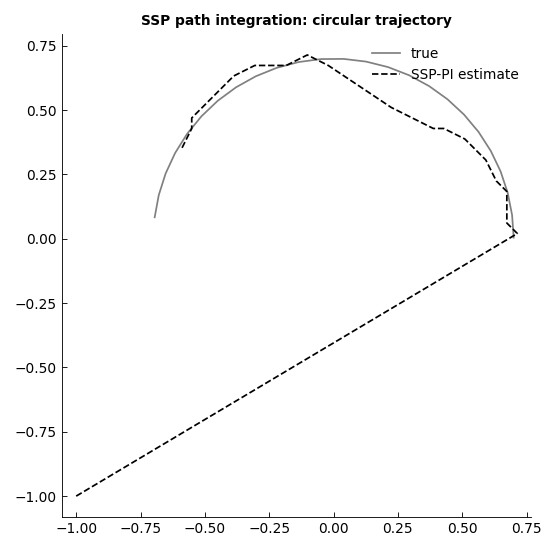
A small CI-friendly demo: the true counterclockwise circular trajectory (gray) versus the SSP-PI estimate (black dashed). Parameters are sized for a fast CI run — a 37-dim hexagonal SSP with 200 neurons per VCO, simulated for 0.5 s. The diagonal line at the bottom of the dashed track is the network's brief uninitialised state before the initialisation node activates at t = 0 (and steers the SSP to the true starting position at (0.7, 0)); after that, the network tracks the trajectory.
With 500–800 neurons per VCO (per the docstring guidance) and slower trajectories, the estimate tracks the truth much more tightly — see Fig. 3 of Dumont et al. (2023) for the high-performance regime.
Generated by examples/example_usage.py.