
nengo-a2c
A spiking Actor-Critic (A2C) reinforcement learning network in Nengo, with an optional Legendre-Delay-Network (LDN) memory of recent rewards and values for n-step / continuous-time TD updates.
Description
This is a vendored, focused cut of rlnet from Bartlett et al. (2022), "Improving Reinforcement Learning with Biologically Motivated Continuous State Representations" (ICCM). The upstream repo contains the full RatBox/CartPole experiment suite and several state-representation variants (SSP, VSA, normalized, one-hot, ...). This submission packages the parts most reusable as a standalone Zoo entry:
- Networks
ActorCritic— basic single-layer A2C, no memory of past rewards. Optional state ensemble.ActorCriticLDN— A2C whose reward and state-value signals are passed through LDN delay-line memories, enabling TD(n) (discrete-time) or TD(θ) (continuous-time) updates from a multi-step return.LDN— anengo.Processimplementing Aaron Voelker's Legendre Delay Network. Can be dropped into anengo.Nodeto provide a continuous memory of the last θ seconds of input.- Learning rules
TD0— single-step TD(0) update.TDt(TD-theta) — n-step / continuous-time TD update that consumes the LDN-stored reward and value traces.- State representations
NormalRep— normalize the env's observation into[-1, 1].OneHotRepCP,OneHotRepRB— discretize the observation and one-hot encode it.
⚠️ License. Upstream is distributed under Applied Brain Research's academic-use-only license, which is not GPL-compatible. This submission preserves that license verbatim — see
LICENSE. Academic research, teaching, and personal learning are permitted without payment; commercial use requires a license from ABR (sales@appliedbrainresearch.com).
Installation
We recommend a fresh virtual environment:
python -m venv .venv
source .venv/bin/activate          # Windows: .venv\Scripts\activate
pip install -r requirements.txt
Usage
The A2C classes are trainer-style — they build their own nengo.Network, instantiate their own nengo.Simulator, and expose a step(state, action, reward, reset=False) method that advances the simulation one timestep and returns the updated state-value and action-values. They're not drop-in nengo.Network subclasses to put inside a parent with model: block.
import nengo
from nengo_a2c import ActorCritic, TD0, OneHotRepCP, softmax

rep = OneHotRepCP(ranges=(5, 5))                 # discrete 5×5 state space
rule = TD0(n_actions=4, lr=0.3, act_dis=0.9, state_dis=0.95)
ac = ActorCritic(rep, rule, neuron_type=nengo.RectifiedLinear())

state = (0, 0)
ac.step(state, 0, reward=0.0, reset=True)        # episode start
state_value, action_values = ac.step(state, action=0, reward=0.0)
probs = softmax(action_values / 0.3)             # softmax action selection
# ... pick action, step env, call ac.step(new_state, action_taken, reward), repeat
examples/example_usage.py is a runnable, CI-tested 5×5 gridworld demo that builds an ActorCritic, trains it for ~100 episodes, and reports the improvement in average episode reward.
The LDN variant
ActorCriticLDN reads the same (state, action, reward, reset) API but routes reward and value through LDN(theta, q) memory nodes — a q-dimensional Legendre basis of the last theta seconds. The TDt rule then computes an n-step return by integrating the LDN's stored reward trace against pre-computed decoder weights:
from nengo_a2c import ActorCriticLDN, TDt, OneHotRepCP

rep = OneHotRepCP(ranges=(5, 5))
rule = TDt(n_actions=4, lr=0.1, act_dis=0.85, state_dis=0.9, n=3, env_dt=0.01)
ac = ActorCriticLDN(rep, rule,
                    state_neurons=200, active_prop=0.1,
                    theta=0.03, q_r=6, q_v=6,
                    continuous=False)
The continuous=True path computes the decoder by integrating against a continuous discount factor instead of summing over n discrete time-steps, which is the paper's TD(θ) variant.
How it works
The actor-critic is implemented as a single linear "weight matrix" rule operating on the state representation (or on neural-ensemble activities of that representation), updating both a scalar state value and a vector of action values from the TD error. There's no separate critic network; the same weight matrix carries both heads.
state ──► [rep.map] ──► [optional Ensemble] ──┐
                                              ▼
action ─────────────────────────────────► [rule Node] ──► state value
reward ─────────────────────────────────►              └► action values
reset  ─────────────────────────────────►
The LDN variant adds:
                                              ┌──► [LDN reward] ──► [decoder] ──┐
reward ────────────────────────────────►──────┘                                  │
                                                                                 ▼
state value (fed back) ────► [LDN value] ──► [decoder] ──► [rule with multi-step return]
The decoder weights for the reward LDN are computed once at network construction, from the Legendre coefficients of the discount kernel — either a discrete sum (continuous=False) or a continuous integral (continuous=True).
What's not vendored
To keep this submission focused, the following parts of upstream rlnet/ are not included:
sspspace.py(Spatial Semantic Pointer construction) — large; warrants its own submission. See the existingssp-path-integratorzoo entry for an SSP-based network.representations/ssp.py,representations/vsa.py,representations/onehottransform.py— depend on SSP/VSA machinery or RatBox-specific transforms.rules/td0iG.py,rules/tdlambda.py,rules/tdn.py— TD variants that overlap heavily withTD0andTDt.- The
cartpoleExperiments/,ratboxExperiments/,figures/, NNI hyperparameter configs, and the upstreamutils.pyplotting helpers (plot_policy,get_ac_output,save_gifs, etc.) — environment- and analysis-specific.
If you want any of these as a separate submission, the upstream paths above are the starting point.
Citation
@inproceedings{bartlett2022rl,
  author    = {Bartlett, Maddy and Simone, Kathryn and Dumont, Nicole Sandra-Yaffa and
               Furlong, P. Michael and Eliasmith, Chris and Orchard, Jeff and Stewart, Terry},
  title     = {Improving Reinforcement Learning with Biologically Motivated
               Continuous State Representations},
  booktitle = {Proceedings of the 20th International Conference on Cognitive Modeling
               (ICCM 2022)},
  year      = {2022},
  url       = {https://mathpsych.org/presentation/1221},
}
License
Applied Brain Research academic-use-only — see LICENSE for the full upstream terms. This is not a free-software license; commercial use requires a paid ABR license.
Figures
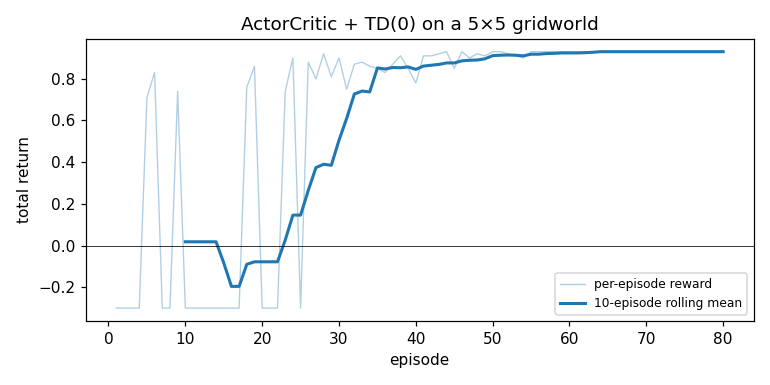
Learning curve from the examples/example_usage.py script — an ActorCritic with one-hot state representation and a TD(0) learning rule trained for 80 episodes on a 5×5 gridworld (goal at (4, 4), -0.01 per step, +1 at the goal). Action selection is softmax with temperature 0.3.
Light line: per-episode total return. Bold line: 10-episode rolling mean.
The agent starts with random exploration in the first ~15 episodes (per-episode return ≈ -0.3, the floor when the goal isn't reached within the 30-step budget), starts hitting the goal intermittently around episode 15 – 20, and converges to a near-optimal policy by episode 50 (return ≈ +0.93, which corresponds to roughly 8 steps to the goal). The same code with n_episodes and max_steps_per_episode scaled up reproduces the curve at higher resolution on local hardware.