
spa-routed-sequence-cleanup-all
A spiking SPA model that cycles a state vector through a five-step sequence (A → B → C → D → E → A) under basal-ganglia / thalamus action selection, with a continuous-readout cleanup ensemble that lights up whichever vocabulary element the state currently matches.
Description
This is example 4 of chapter 7 of How to Build a Brain (Eliasmith, 2013), distributed with nengo-gui as 4-spa_sequencerouted_cleanupAll.py.
The base model is the routed-sequencing pattern from earlier in the chapter: a recurrent state SPA module holds a semantic pointer, and six basal-ganglia actions implement the transitions
dot(vision, START) --> state = vision
dot(state, A)      --> state = B
dot(state, B)      --> state = C
dot(state, C)      --> state = D
dot(state, D)      --> state = E
dot(state, E)      --> state = A
After a brief vision = 0.8*START+D pulse, the model picks up at D and cycles forever.
What this example adds is the cleanup-all read-out: a scalar nengo.Ensemble of 300 neurons whose vsize-dimensional input is the inner product of the live state output with every vocabulary vector. Each dimension i of the cleanup ensemble rises only when state is most similar to vocabulary item i. In the GUI's Value plot you see a moving bump that walks through the dimensions in sequence, providing an explicit "which symbol is loaded right now" trace alongside the SPA similarity plot.
(The previous chapter-7 example projects only the A direction onto a single scalar. This one generalizes to the whole vocabulary — hence "cleanup all".)
A note on nengo.spa vs nengo_spa
This script uses the legacy nengo.spa module that still ships inside core Nengo. The newer, separately maintained nengo_spa package has a redesigned API. Both run today, but new submissions are generally encouraged to prefer nengo_spa; this submission preserves the original tutorial verbatim.
Run it
In NengoGUI (the intended way to view it):
pip install nengo-gui
nengo spa_routed_sequence_cleanup_all.py
Or just at the command line:
python spa_routed_sequence_cleanup_all.py
How it works
The cleanup transform is built explicitly rather than via SPA syntax. The script asks the state module for its output vocabulary in creation order, stacks each vocabulary vector into a row of a transform matrix pd, then attaches one nengo.Connection(state.output, cleanup[i], transform=pd[i]) per vocabulary item. The result: cleanup[i] ≈ state · vocab[i], which is exactly the cosine similarity used by the SPA cleanup memory.
Dimension 0 of the vocabulary is START, which is the role pointer used only by the first action — projecting it would just produce a constant signal during the kickstart pulse, so the loop deliberately starts from i = 1.
The feedback=1, feedback_synapse=0.01 on the state module produces a near-perfect integrator over a 10 ms time-constant: long enough for each action to settle into the new symbol before the next BG transition fires, short enough that the cycle keeps moving.
Citation
@book{eliasmith2013htb,
  author    = {Eliasmith, Chris},
  title     = {How to Build a Brain: A Neural Architecture for Biological Cognition},
  publisher = {Oxford University Press},
  year      = {2013}
}
License
GPLv2 (see LICENSE).
Figures
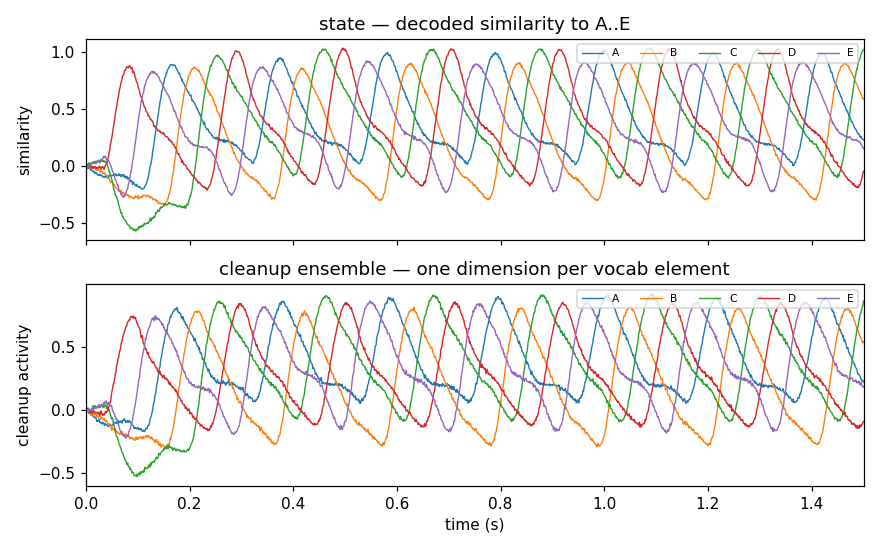
1.5 seconds of the routed-sequence + cleanup-ensemble network, produced by running spa_routed_sequence_cleanup_all.py directly.
For the first 0.4 s the network is primed with 0.8 * START + D; after that, the routing actions in the basal-ganglia / thalamus loop cycle the state through A → B → C → D → E → A → … with each element holding for roughly 60 – 80 ms before the next transition is selected.
Top — state output. Similarity of model.state to each of the five sequence elements. Each transition shows up as a near-square hand-off from one curve peaking near 1.0 to the next; the small overlap during each transition is the BG/thalamus settling onto the next selected action.
Bottom — cleanup ensemble. The 16-dimensional vocabulary projected through the per-vocab-element transformation matrix pd onto a 6-D ensemble. Each plotted dimension fires roughly in lockstep with the corresponding state similarity above. This confirms that the cleanup ensemble is acting as an explicit categorical decoder of the rotating semantic-pointer state.